Thursday, March 8, 2012

Spring Peepers

It is definitely early this year, but last night I heard the thrilling (at least in my mind) trill of the spring peepers as I cruised home from work.  They are in my mind the second harbinger of spring!  Can you remember the first?   A few years ago there was a scuttlebutt that if I remember properly involved some East Marlborough residents complaining about a noise violation....guess who the culprit was?!  I know you've seen the photo before, but I just can't resist showing it again.  Can you believe how tiny these guys are?  They do make quite the ruckus, but a noise violation, come on guys!  The sound is coming from the males calling for the females to mate.  The coloration of the animals can vary but they all have an X on their back. They are fairly nocturnal, so you rarely get a glimpse of them!

To me, all that ruckus means that the sweet sound of spring is here (and my favorite season is not far behind!) If you haven't been privileged to hear the ruckus, click on the brief video to hear the sweet sound of spring.

This of course means that your invasive control "to-do" list has gotten very long very rapidly! I just saw my first celandine in bloom today, along the Brandywine of course.  Tomorrow, we'll discuss the other invasive of spring that has already presented itself: Alliaria petiolata.  I'll leave you to mull over the common name until tomorrow when we'll discuss control, identification, and it's horrible allelopathic tendencies. 

Monday, March 5, 2012

Little Brown Jobs

Little Brown Jobs or LBJ's are known throughout the ornithological community as birds that are difficult to identify and typically include: sparrows, wrens, finches, or warblers.  We will concentrate solely on sparrows and then have you see if you can identify the LBJ in the photograph below.  

How to Identify Sparrows by Markings

The easiest way to identify these small, active birds is by their field markings. Though they’re not always clearly visible, most sparrows have at least one strong field mark unique from other sparrow species.  Ask yourself the following questions about identification:
  • Head: Is the head smooth and flat, or does it have a small crest? Are there stripes or markings on the crown, eyebrow, cheek, chin or throat? Does the bird have a noticeable eye ring?
  • Tail: Is the tail long or short? Are there distinguishable markings on the tail?
  • Underparts: Does the birds chest have any markings? Are they in a distinguishable pattern or random?
  • Wings: Is there barring or other distinguishable markings on the wings? If barring is present, is it narrow or wide?
  • Bill: Note the size of the bill in relation to the birds head.  Notice whether the color of the bill and if the top and bottom have the same color.

Other Ways to Identify Sparrows

 You may not be able to get a good look at the sparrows to see distinguishable markings, so you may have to rely on one of the following keys to identification.
  • Range and Habitat: Each sparrow has a habitat that it prefers, noting habitat can help to narrow down the choices.
  • Song: If you are not an expert birder, try to remember the song that you hear and listen to recordings to match up what you heard to identify the bird.  Cornell, and iTunes both have a fairly comprehensive library of bird sounds.  There are also a few good apps for your smart phone if you search around.
  • Behavior: Are the birds solitary or moving in flocks? Are they shy or fairly open about interaction with you as the birdwatcher?  This is another key that can help to I.D. the bird. 
I find that spending time getting familiar with the sparrows in your area is a great start to identification.  Investing in a good field guide is the first start on your way to identification.  Lastly, if you aren't able to ID the bird, that's OK.  The more practice you have, the better you will get and even experts make mistakes sometimes! I am a fairly novice birder, and couldn't have been more excited the day that a more experience birder thought that a dove was a kestrel--granted we were quite far away from it, and it was only a glimpse, but it gave me hope for the future!!

Hope you can identify the bird I saw at SWP on February 28 from the above photograph.  I found this bird perched on the brushy edge between the meadow and a small creek but in fairly open habitat.  

Friday, March 2, 2012

SPRING BOX CLEANING

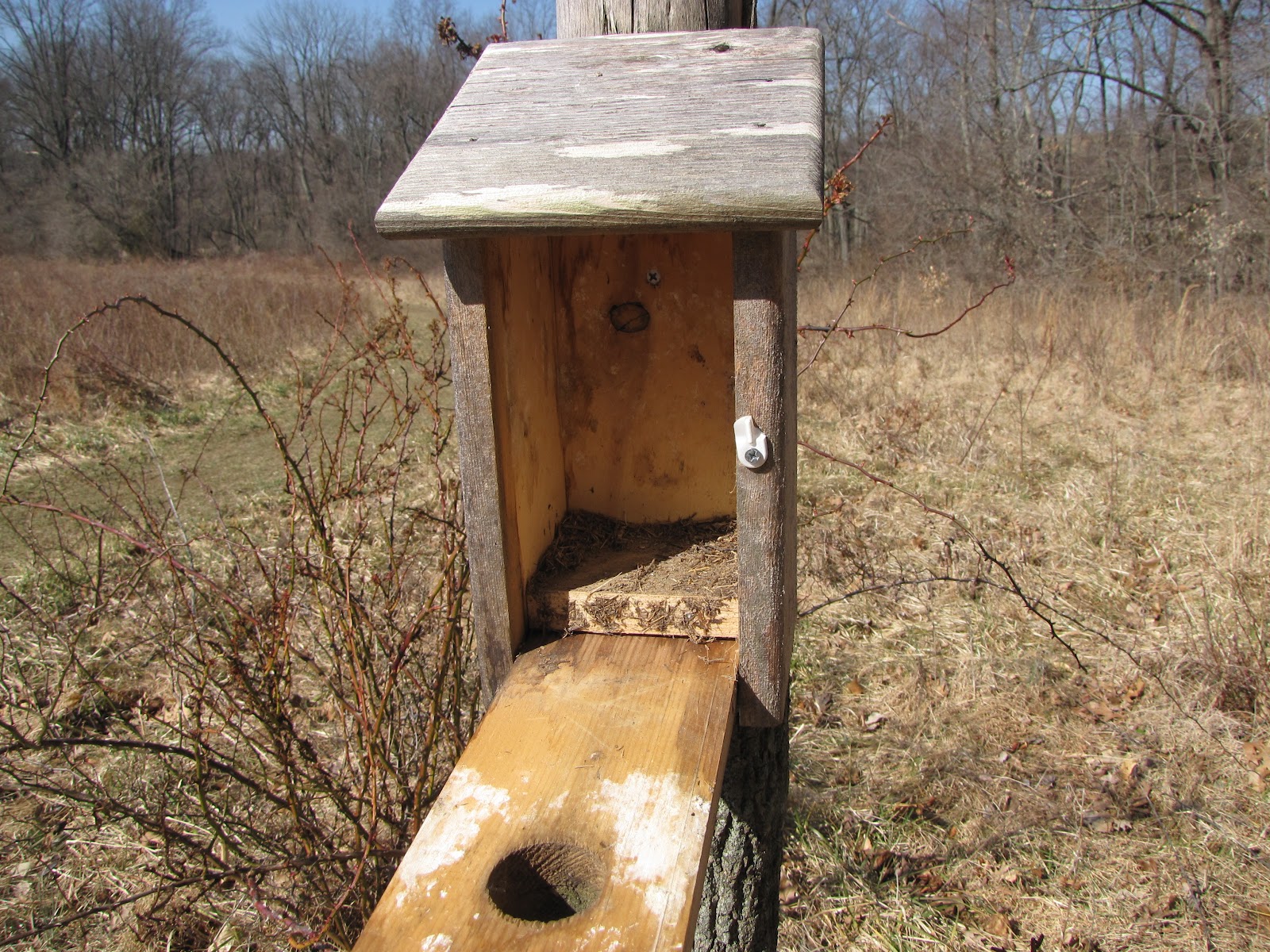
Spring cleaning should be on your "t0-do" list this weekend.  I know it's seems early, but it is March, and I have seen bluebirds actively making their nests already!


We already discussed being a good landlord, so the time has come to evict your winter residents--typically mice as you can see in this photo of a nesting box at Stateline Woods.  This will lead way for bluebirds looking to make their nest this spring.  I typically use a stick to clear out the nests, I feel bad for the little white footed mice who lose their home, but they'll find another, and we have the boxes specifically hung for the bluebirds.

I have been unsuccessful in my attempts thus far to take the picture of the bluebird scoping out the nesting boxes by the parking lot at Stateline Woods.  Feel free to send any good pictures you get of our bluebirds my way! 

If you don't have a bluebird box, you can purchase them at TLC's offices!


You should also be collecting your cedar chips and thinking about clearing out the wood duck boxes and replacing the wood chips with fresh wood chips.  Remember to check for overwintering squirrels and look carefully in the chips to see if you find any owl pellets.  If you find some, it is always find to tear them apart to see what your resident owls have been snacking on!

Monday, February 27, 2012

Not all yellow flowers are cheery

I promised information about Ranunculus ficaria (lesser celandine) since I saw my first clump of Ranunculus threatening to bloom last week. I also discovered quite a few more plants while hiking this weekend.   I will spend some time pulling out some of the invasives along a trail as I am hiking.  It is very important to leave no trace when you hike and take only pictures but, I can't resist some of the very invasive plants such as celandine, garlic mustard, and small euyonomus trees.  Please, if you are going to do a "good" deed such as invasive removal on a property that you are hiking YOU MUST BE VERY CONFIDENT OF WHAT YOU ARE REMOVING, AND RECOGNIZE WHETHER THE PROPERTY OWNERS/MANAGERS ARE LIKELY TO PRACTICE INVASIVE CONTROL. SOME OF OUR NATIVE PLANTS CAN BE MISIDENTIFIED AS AN INVASIVE SO MAKE SURE YOU KNOW WHAT YOU ARE TARGETING!


If you are not sure what the plant is, you may recognize the photograph of the yellow carpet.  This scene is repeated many times throughout the Brandywine in the spring.  It is a small low growing plant with a very impressive underground network of bulbets and tubers that can continue to flourish if separated from the main plant.  The flower is typically bright yellow and the leaves are a deep green. 

The leaf of celandine, which is the only part of the plant that is currently showing, looks VERY similar to the leaf of a violet.  Note in the photograph the violet is on the left and the celandine is on the right.  Violet's tend to have more rounded lobes, and the celandine is sharper with points.  Typically the celandine has a glossier look than the violet.  You should be sure that you can differentiate between the two before you pull out leaves that belong to violets.   Once they bloom, they are easier to differentiate, but not all violets are purple or white, there are yellow violets native to our area.  Also, once the blooming has begun, it is typically more difficult to remove all of the tubers from the ground.

 When you pull out the celandine be sure to remove all of the tubers and bulbets that are attached to the plant.   You can actually assist in the spreading of the plant by leaving them behind.  I will lay the plant on a rock where it has little chance of re-sprouting in the ground.  You can also control celandine by spraying a glyphosate based herbicide at a low concentration.   Glyphosate is non-selective so it should be used with care since you may harm some of the spring ephemerals in the process.  If the area is very sensitive, I would recommend individually painting each celandine leaf.  This may be time consuming, but it is a great way to be very selective and to inhibit any further spread. Typically manual control is recommended for very small infestations and you will have to resort to chemical to obtain complete control when you are dealing with the "blanket" effect as in the earlier photograph.

Monday, February 13, 2012

Are you celebrating National Nest Box Week?

National Nest Box week was organised by the British Trust for Ornithology in 1997 (hence the spelling of the word organized) in order to build awareness about the loss of habitat for nesting birds.  They encouraged the building and placement of bird boxes throughout the UK to counteract the removal of trees.  They estimate that currently 5-6 million boxes  have been placed in gardens around the UK due to this initiative.  
Bluebird Boxes have helped to combat the decline of bluebirds through our country!

The Avian Promise has coordinated with the BTO to bring this fabulous idea across the pond. At TLC, we strongly support the placement of nesting boxes and encourage National Nest Box week to go worldwide.  We have come up with some things you can do to prepare nesting sites for our avian friends this spring:
  • Build your own nesting boxes. There are many different types of boxes to choose from depending  type of habitat you have in your backyard and your skills as a carpenter: Bluebird, Wood Duck, Bat, Screech Owl, Kestrel, Barn Owl, Wren are just a few of the many boxes to choose from.  We recommend purchasing Landscaping for Wildlife from the PA Game Commission at: www.theoutdoorshop.state.pa.us for the most comprehensive and correct dimensions for building boxes.
  • Purchase a bird box from your own local conservation organization.  At TLC we currently have bluebird boxes for sale for $20 a piece, contact our offices if you are interested.  We recommend that you purchase and hang two bluebird boxes in order to ensure that bluebirds will use your box.
  • If your property is not sufficient for the box that you would wish to see hung, you can typically sponsor a bird box at your local conservation group's nature preserve.  You can assist with cleaning out the boxes and receive updates about what is living in your box from the organization.  You can sponsor a box at TLC's  Stateline Woods Preserve by clicking HERE.
  • If you are not interested in boxes increase nesting opportunities by planting shrubs or trees around  your property.


Early March, we will discuss the spring cleaning of your boxes! Happy National Nest Box Week, even if you are on our side of the pond!

Wednesday, February 8, 2012

What I saw on my drive to work this morning...

It was quite an eventful drive on my way to work today and per my usual escapades it involved stopping in the middle of roads and backing up to get a better view of what I thought I had seen.  Luckily my commute involves many back roads where I pass more pedestrians, bikers, and horseback riders than cars! 
 
So first, I looked to my right as a passed over a bridge and this caught my attention.  I stopped and backed up in the middle of the one lane bridge for a better look.  It was well worth the potential to irritate commuters on their way to work.


Then a little further down the road, I happen to notice something white floating in the Brandywine.  I apologize for the next couple of pictures, the camera that I always keep for such emergencies does not take the best quality pictures.


Note the common merganser with the brownish red head is the female.  There was a total of five males and two females.

I looked on the road right where I happened to stop and noticed a fair amount of whitewash on the road.  This was probably from a large bird spending time in one of the trees above.  I was looking to see signs of pellets since barred owls have been spotted here in the past, but came up with nothing.  The white wash indicates something big, perhaps the eagle I had seen or what I saw next..... 


So a little further down the road I saw a large blackish brown spot in a tree across the creek.  I backed up to get a closer look, and found my second bald eagle of the day! This one was immature.  I was able to get a shot of it as it started to fly away, but again the quality leaves much to be desired.  

All good fun in my twenty minute commute,which took quite a bit longer this morning.  Again, though I recommend taking in what is around you because you never know what you are going to see, it is best if you have a driver as you gawk at the sides of the road.  Just ask my husband.......since I obviously tend to drive and gawk.......


Monday, February 6, 2012

White Nose Syndrome and it's effects

CLEARING UP THE AIR: 

Bats get a bad rap because of a few common misconceptions: most bats carry rabies, they are blind, and they have no benefit to humans whatsoever.  Let's clear up these  misconceptions before we go any farther.  
  • Of the 450 positive cases of rabies in PA in 2011, 34 were bats.  7.5% of the total animals who tested positive for rabies were bats; to me this indicates that very few bats actually are rabid. 
  • Bats are not blind, but they do not have very good eye sight, they rely mostly on sonar.
  • Bats are very beneficial to humans, insects like mosquito's are among their favorite foods.  This means more bats=less bug bites.  If you are someone who draws bugs to you like I am, you should love bats!  

Have you noticed bats flying around outside during the day or active in winter? Bats exhibiting strange behavior are being sited throughout the state of Pennsylvania are showing signs of White Nose Syndrome (WNS). 

WHAT IS WHITE NOSE SYNDROME (WNS): 
Many species of bats rely on hibernation for survival in the winter months.  WNS is named for the white fungus that appears on the muzzle and other body parts of affected bats.  Bats with WNS exhibit uncharacteristic behavior during cold winter months, including flying outside in the day and clustering near the entrances of hibernacula. This mobility during the hibernation months leads to starvation in the bats.  They have energy stored up throughout the winter months to last by hibernation, but the energy expended by waking and flying about ends up being very expensive energy that the bats are not able to recoop.  They are not able to find insects, their normal source of food, so they are not able to restore the energy that they have lost by coming out of hibernation.  Bats have been found sick and dying in unprecedented numbers in and around caves and mines. WNS has killed more than 1 million bats in the Northeast and Canada. In some hibernacula, 90 to 100 percent of bats have died.  WNS is continuously wiping out bat colonies throughout the state of Pennsylvania!   There is still much data and information to learn about bat colonies and the effect of WNS. 

HOW CAN YOU HELP:  
  • If you see bats exhibiting strange behaviour, please contact your local state wildlife agency; in SE PA you can contact: Dan Mummert, Conservation Biologist for the PA Game Commission.
  • TLC recognizes WNS and has a bat box sponsorship to continue to provide homes for bats.  Click HERE for more information.  The hope is that the more colonies that form, the less colonies that will be affected by WNS. We can also use our colonies to partner with the PA Game Commission biologists to continue to track WNS.  

Popular Posts